
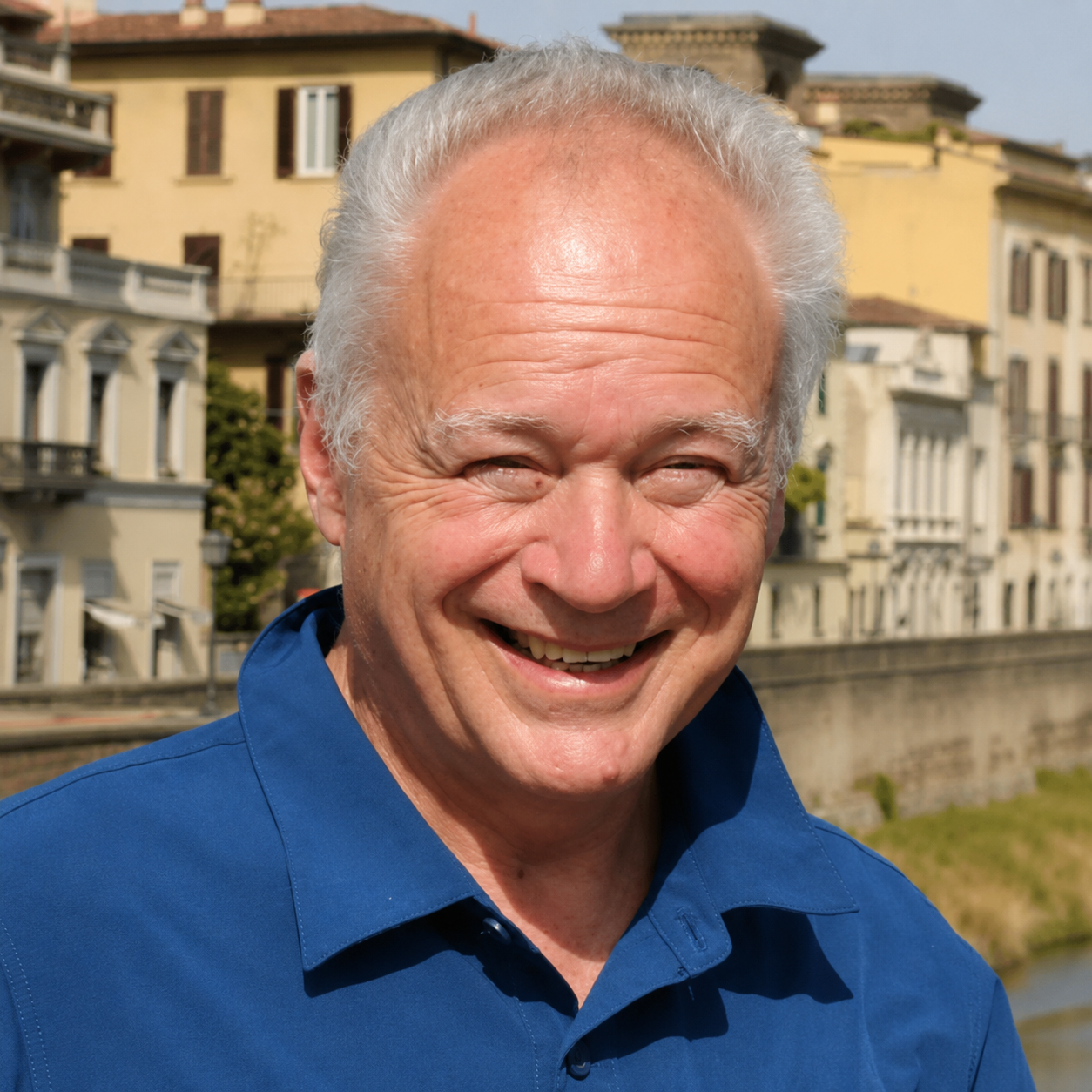
RegulatingAI Expert
Paul Werbos
Adjunct Professor, Kummer Institute Center for AI and Autonomous Systems
USA Speaks English, French, Spanish
“Translating frontier AI risk into policy that legislators can actually use.”
About Paul
Paul Werbos is best known (and most cited) for the original discovery of backpropagation, and for the theorem establishing its validity, as part of his PhD thesis in Applied Mathematics for Harvard in 1974. Even before 1974, he had developed backpropagation as one element of a more general approach to reinforcement learning, which combined a new way to learn to approximate dynamic programming with key insights from Freud’s theory of how learning works in neurons of the brain. He inaugurated the field which we now know of as RLADP, Reinforcement Learning and Approximate Dynamic Programming, building on this earlier work, his later papers, and on the research area of Adaptive and Intelligent Systems at NSF which he led from 1988 to 2015. This included neural networks, adaptive fuzzy logic, and a major paradigm shift in how to understand intelligence in the brain, which has passed tests on the best real-time brain data (Werbos and Davis 2016).
Backpropagation and RLADP are the main foundations of the new deep learning revolution, which can be traced back to a research program he started at NSF, Cognitive Optimization and Prediction (COPN), and to an award he pushed there to Andrew Ng and Yann LeCun, whose success stories they conveyed to Sergey Brin at Google. AIS also led to more powerful and advanced developments and applications of RLADP, where massive new breakthroughs are still appearing, in areas from electric power, to the control of air and ground vehicles, and in new options for quantum technology for observing the sky, quantum RLADP and cybersecurity. These are reviewed in his new paper, Quantum Technology to Expand Soft Computing, in Systems and Soft Computing (Elsevier), December 2022.
Paul Werbos has probed deeper into how climate change actually does pose a threat to human species existence, and how new IEEE technology and market design could be combined to solve these problems at a much lower cost than any of the well-known existing approaches. These efforts have only just begun, but they have demonstrated already how IEEE technologies (which include market design as in electric power) would allow vastly more impact than present climate policies, at lower cost, and faster. (build-a-world.org).
He has also been active for decades in IEEEUSA, in the planning committee of the Millennium Project, and in the National Space Society. In 2009, as a legislative fellow handling climate and many other areas of science for Senator Specter, he learned the realities of many S&T challenges facing the world today.
Areas of Expertise
Climate Change
Foundation model oversight, licensing regimes, and the design of enforceable regulation across US and EU frameworks.
Leadership
Pre-deployment evaluation, red-teaming standards, and accountability structures for high-risk systems.
Machine Learning
Governance of autonomous systems, dual-use risk, and export-control implications for national security.
Neural Networks
Foundation model oversight, licensing regimes, and the design of enforceable regulation across US and EU frameworks.
Quantum AGI
Pre-deployment evaluation, red-teaming standards, and accountability structures for high-risk systems.
Experience
Director of AI Governance
Senior Policy Advisor
Research Scientist
Credentials & Affiliations
- Advisory committee, international AI safety standards body
- Fellow, National Center for Technology Policy
- PhD, Computer Science
- Member, IEEE Standards Association

Work With This Expert